

In the far northeast of Russian Poland, where the Netta River feeds a chain of lakes and a long canal cuts a straight line through the reeds, sat the town of Augustów. It was a Shtetl, a small Jewish town, ringed by water. Today it lies inside Poland, and out of it came the Gibstein family.
Rabbi Yehoshua Gibstein was born in Augustów in 1883, son of Betzalel Ze'ev.¹ He studied at Volozhin, the great Lithuanian academy of Talmud, and gave his days to study and to prayer.² He married Kendel Yocheved Povembrovski, a daughter of Augustów, joined the religious-Zionist movement, founded its local chapter of pioneers, and opened his home to the first young people bound for the Land of Israel. In time he gave himself fully to the Rabbinate, and his first major work went to press in 1924, a commentary on the Ethics of the Fathers.³
When his American brother-in-law urged him to cross the ocean, the Rabbi refused to set foot in what he called The Unfit Land, and chose the Land of Israel instead.⁴ He brought the family up to Rishon LeZion, one of the first farming towns of the Yishuv, the Jewish community then putting down roots in the land.
Yaacov was born in Rishon LeZion in 1928.⁵ His father pressed the same rigor onto him early, and the record of his schooling is thin, by some accounts no formal schooling at all, only what he took in at home, the Jewish learning and the pull toward mysticism his father lived by. Somewhere along the way Yaacov Gibstein took a new name. He became Agam, אֲגַם, the Hebrew word for a lake.⁶
He left home young. At eighteen, in 1946, he went up to Jerusalem to study painting at Bezalel under the Bauhaus-trained painter Mordecai Ardon, and it was Ardon who told him to go further. In 1949 he left for Zurich and the workshop of Johannes Itten, whose famous course taught color as a language with its own grammar. Paris came in 1951, when Agam was twenty-three. He enrolled in Jean Dewasne's studio of abstract art and fell in with the painter Auguste Herbin, in a city he later remembered as alive after a murderous war, full of artists from all over the world.
By 1952 he was building the first of the works that would carry his name, surfaces of narrow triangular slats painted differently on each face, so a viewer walking past saw the picture compose and recompose without end. His first one-man show opened at the Galerie Craven in Paris in 1953, when he was twenty-five, and it is often called the first solo exhibition in history given over to kinetic art. A Paris critic caught it at once.
Agam, a young peasant born in the mountains of Israel, has invented a kind of mobile painting.
René Barotte, "La peinture qui bouge," Paris-Presse, 2 November 1953 (translated from the French)
He described colored shapes pinned to a board that any passerby could rearrange at will, and asked whether these were puzzles or works of art. By 1955 the experiment had a movement and a name. The group show now remembered as the birth of kinetic art hung Agam, then twenty-seven, beside Calder, Duchamp, Soto, Tinguely, and Vasarely, and gave him the dealer who would carry his work for the rest of his life. Agam described his own method.
I can paint up to eight distinct themes in one work. These appear to be integrated with one another if one stands straight in front of the picture, but they separate and recompose in turns when one moves to the right or the left.
Yaacov Agam, 1962 Griffon monograph, via Frank Popper, "Origins and Development of Kinetic Art," 1968
The aim, he said in 1964, was a work no one could take in from a single spot, a partial revelation and not the perpetuation of what already exists. You had to move to see it, and in moving you became part of the making. His first show in Israel opened at the Tel Aviv Museum at the end of 1958, when he was thirty, and the museum's director said the work liberated, and even broke, many accepted conventions. Rabbi Yehoshua Gibstein died two years later, in 1960, at seventy-seven. In 1981, at fifty-three, Agam was received at the White House, where President Ronald and Nancy Reagan welcomed him by both of his names at once, Yaacov Agam and Gibstein. In 2008, he said:
The only constant in life is change. Static art is a gravestone.
Yaacov Agam, JTA interview
Fast forward to 2019, and to a fence at a hotel in Miami Beach, on Normandy Isle. Not just any hotel: the International Inn, a 1952 Melvin Grossman design, historically designated, gorgeous and timeless. Agam was a direct inspiration on the paint pattern I worked out for that fence. Instead of one solid color, we did two tones, a soft teal and white, across a staggered face of posts cut to different heights.
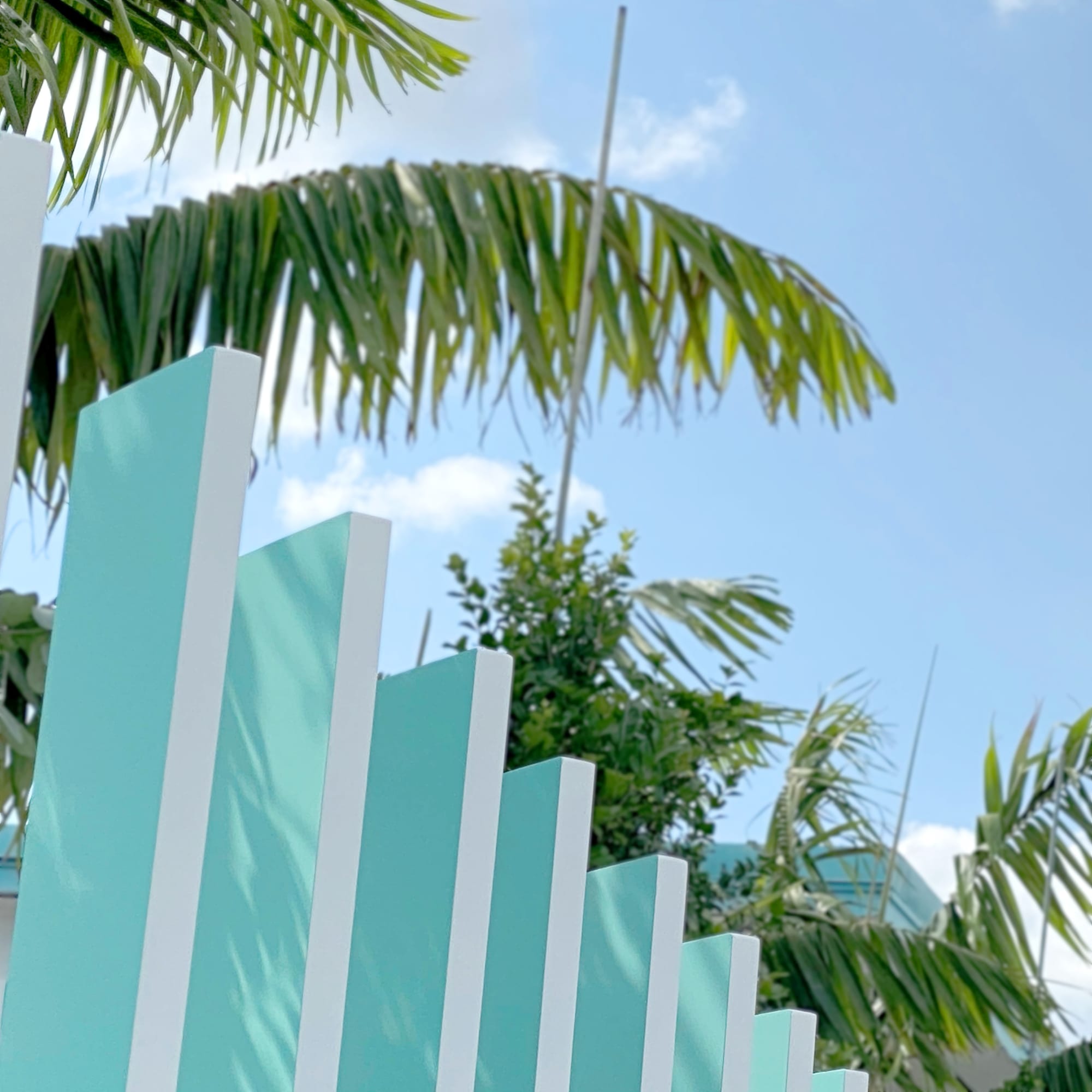
Walk past it one way and the fence reads as a single color. Walk past it the other way and it turns into another. The angles do the rest, so the whole thing seems to shift as you move, a quiet kinetic effect on a thing nobody usually looks at twice. (Luis Barragán was in my head too, the way he let colors hide on different surfaces, to be found by exploring.) Two colors of paint turned one fence into multiple experiences, each one unique depending on where you stand and how you meet it.
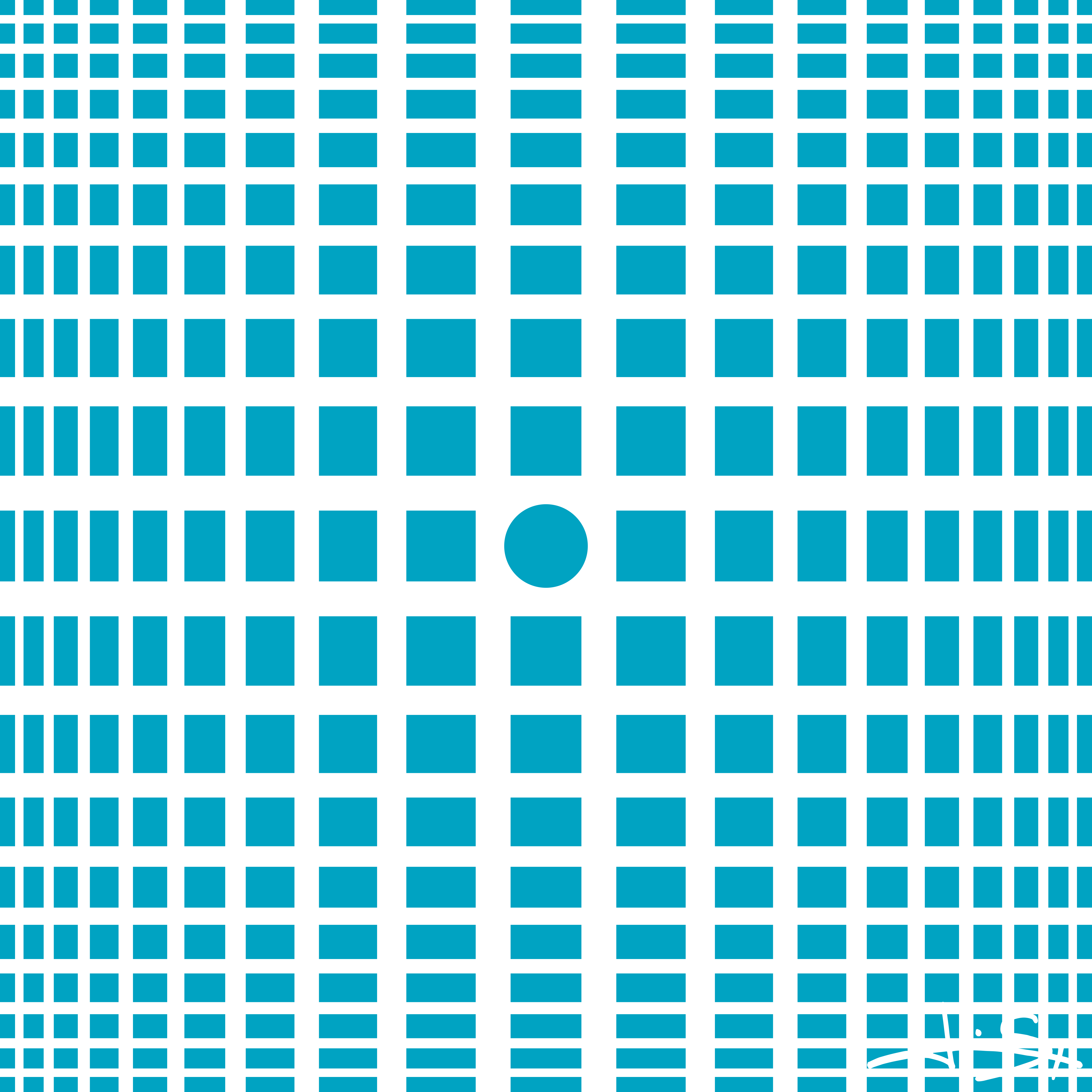
On June 21, 2026, Yaacov Agam passed away at the age of ninety-eight. I made a piece inspired by his work and his ideals, called 18x18, part of the Archigraph series.
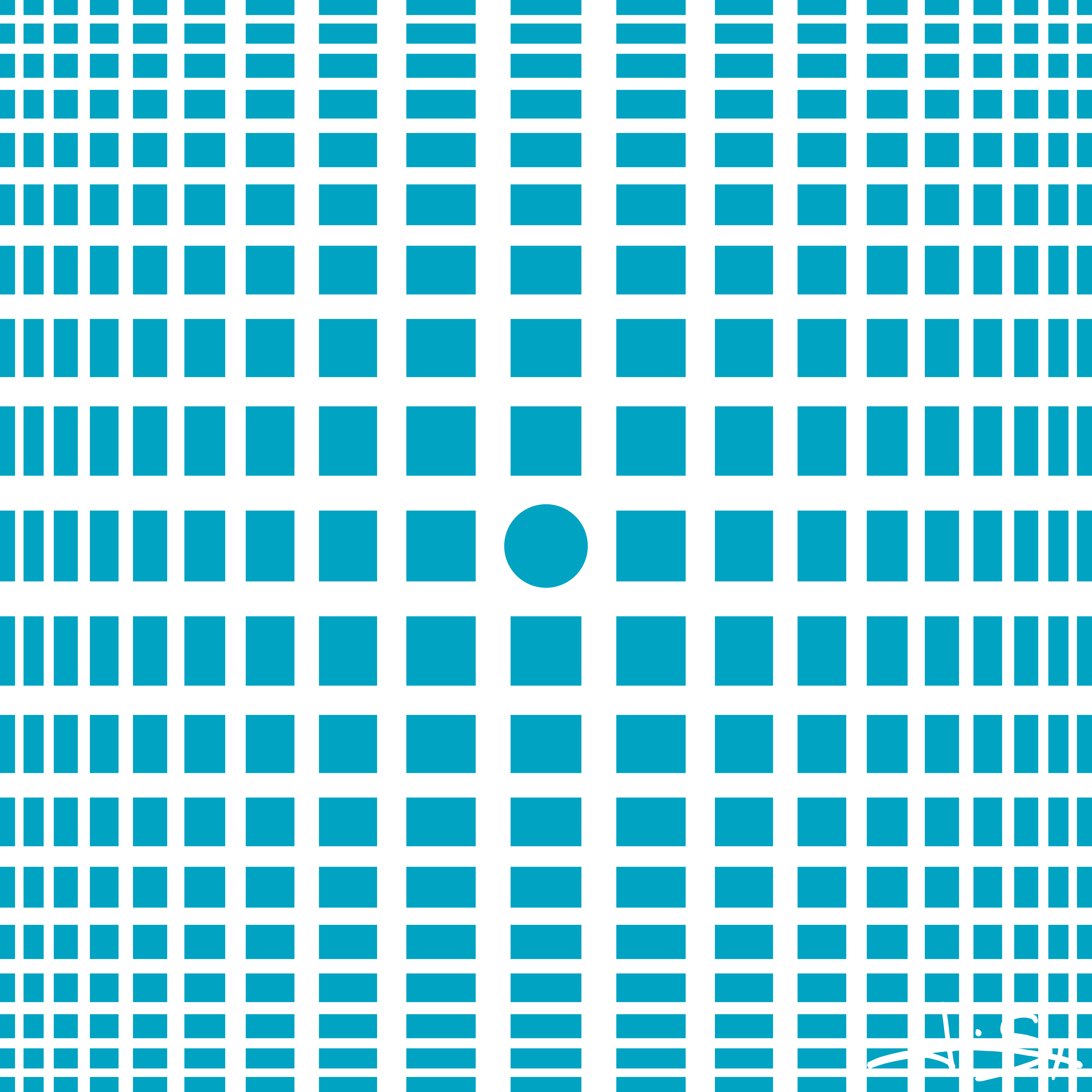
The numbers carry his meaning. The grid runs eighteen by eighteen, and eighteen is chai, the Hebrew word for life. In the middle I set a single circle. It breaks the grid of straight lines and gives the eye one place to land, the way Jasper Johns dropped a single dot into his inverted US flag paintings so your eyes had somewhere to focus and the illusion could take effect. The circle is also there to be the one thing unlike everything around it, a center, the way Jerusalem is held to be the center of the world. More than anything it is there to retrain the eye, to teach you how to relax and look at the world.
Then there is the kinetic version, because you cannot stop at a still image with Agam. The original idea was to create motion through the still image, and there was still more to do with color and movement. Switch on your microphone and it moves to the music or the noises around you. It reacts to taps as well.
Footnotes
- The Augustów memorial book carries the Rabbi's memoir, written by his son Betzalel, though its header mislabels him "Betzalel Ze'ev." His own books, and the Israeli records, give Rabbi Yehoshua, son of Betzalel Ze'ev Gibstein.
- "All his days were dedicated to the study of Torah and the service of God. He fasted a lot, until he became weak." He postponed his own wedding until his strength returned, and was known as a silent man who would not speak ill of others.
- His books: a commentary on the Ethics of the Fathers (Pirkei Higayon, Biłgoraj 1924), noticed in the Warsaw paper ha-Yom in January 1925; the two-volume Da'at Torah, "the View of the Torah" (Piotrków 1932); Cheker Kohelet, a study of Ecclesiastes; a short work on man and the Sabbath (Rishon LeZion 1941); booklets for the Beit Yaakov, "House of Jacob," girls' school he ran; prayer pamphlets; and an unfinished volume on the Talmud.
- He called it The Unfit Land. The Hebrew is eretz hatreifa, literally "the unkosher land," a name some Eastern European Jews gave America.
- Yaacov's birth is given as 11 May 1928 by genealogical records and the Rishon LeZion museum, and as 21 May by some obituaries. The family's aliyah is usually dated 1931, which sits oddly with a 1928 birth in Rishon LeZion; the Rabbi may have come earlier, or in stages.
- Agam (אֲגַם) is the Hebrew for a lake or pool, as in Psalms 107:35, "a pool of water." Augustów sits in a lake district, ringed by water, by some counts nine major lakes; reading his chosen name as an echo of that town is my own thought, not a documented fact.
- A note on the text: some quotes and sources were translated from Hebrew and French with the help of AI, and there may be small errors.