

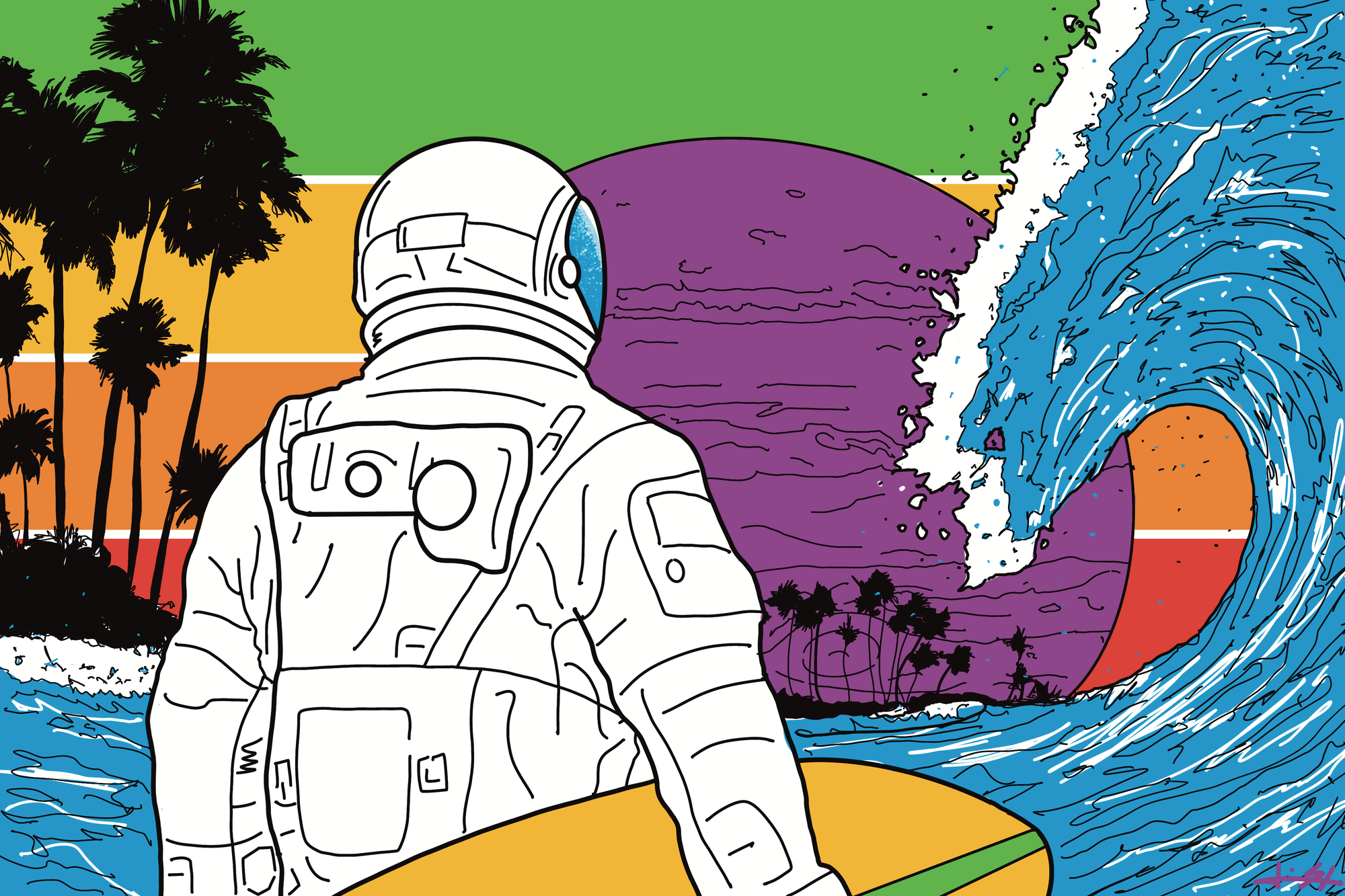
The other night a few of us got into it at a friend's house over education. What it's costing, where it's going for our kids, why none of us feel like the current version is actually working the way it was supposed to. The argument went nowhere and everyone went home. I couldn't sleep after it (I don't usually any night but that's another problem), and the next morning I texted one of the guys what I couldn't stop thinking about.
I'm not an education expert. I'm an Architect, and I'm looking at this the way you look at any institution that hasn't been seriously rethought in a long time, to see if it could be more meaningful. The people inside classrooms and inside the research are the ones to defer to on implementation and content. What I can offer is about the shape of the whole.
Two curves are crossing right about now. The traditional cost of running school keeps climbing, and most families feel that curve even if they don't name it. At the same time Artificial Intelligence is compressing how long it actually takes to teach a standard academic subject. Elon Musk made the broader point at Davos in January 2026:
"With robotics and AI, this is really the path to abundance for all. People often talk about solving global poverty, how do we give everyone a very high standard of living. The only way to do this is AI and robotics. The robots will actually make so many robots and AI that they will actually saturate all human needs. Meaning you won't be able to even think of something to ask the robot for at a certain point. Like there would be such an abundance of goods and services."¹
Education is one of the places where that compression could land first.
The chart below traces annual cost per learner across five US education sectors in constant 2026 dollars, from 1970 to 2026. Public K-12 per-pupil spending, Private K-12 tuition at secular NAIS independent schools, Jewish day school K-12 tuition, undergraduate tuition and fees, and graduate / professional tuition. Every line turns sharply upward across the last fifty years. For comparison, real median US household income grew roughly thirty percent over that same half-century.² Education costs in every sector grew five to eight times faster than the income paying for them. General inflation accounts for a slice of that, but only a slice.
Pair that with what school has actually been for most of its modern history. A room of kids of all levels grouped together because that was the closest school to where their families happened to live. A calendar built around harvests most families don't participate in anymore, preserved now by a tourism industry that runs on winter break, spring break, summer break, and Thanksgiving ski trips and cruises. Good teachers getting harder to find, often barely paid, and plenty of people who would be naturals at the work don't want the job because the job has been broken for a while. A lot of what we call tuition inflation is really families trying to buy their way out of the parts of school that aren't working.
Specialty schools stack another cost on top of the baseline. Magnet programs, religious schools, trade academies, and other specialty tracks all have to meet the federal and state curriculum requirements plus deliver whatever specialty they're known for. That usually works out to roughly twice the cost of a regular school, because they are running two educational tracks in parallel under one roof.
If the public starting core gets cheaper to deliver, the effect could ripple into every other sector on that chart. Public K-12 is the starting core that every other track is priced against. Compress that core through Artificial Intelligence and private, parochial, Jewish day, and the rest can all stop rebuilding the same academic bedrock from scratch. It might not mean every line drops. It could mean real access to specialty education expands, because the specialty part is most of what a family is actually paying for once the core is handled elsewhere.
The core academic part of school could take a short amount of time out of each day, with the length and pace tuned to the particular kid by Artificial Intelligence. Everything else freed up by that compression goes back to the community, to real-life skills, and to the public buildings we already have but mostly don't use for most of the week.
Complementing Patterns
There's a useful distinction in Jewish tradition between two kinds of education³ that English collapses into one word.
The first is Chinuch, which Maimonides⁴ frames as habituation. The slow laying down of basics until they become natural to the child, internal rather than imposed. Rav Samson Raphael Hirsch⁵ takes it further and says that because every child is different, Chinuch has to be tailored to the one in front of you.
The image worth borrowing is the set table. Chinuch sets the table, ready for whoever sits down.
Limmud is the second kind, and it's the meal itself. The cuisines that pass through, the food, the tableware, the decoration, the conversation around the table, the whole experience of sitting at it. The depth, the why behind the what, the mastery that builds on top of the foundation once the foundation is actually there.
A real education is the overlap of many sources, most of them small. One teacher on one afternoon. A neighbor who happens to know a trade. A grandparent's story told enough times that it sticks. A book left on a shelf. A correction a kid never forgets. These are capillary. Capillary waves are the smallest ripples on a water surface, the ones that form first under a breath of wind, before any larger wave can build. Every person's education is the interference pattern of thousands of them, overlapping.
Artificial Intelligence becomes one more source in that overlap, well-suited to the foundation layer especially. It can pace to the particular child, notice what isn't landing, adjust, come back later. One kid's academic block might be ninety minutes, another's three hours, another's something in between, each of them getting what they need and nothing more.
The shape I'm describing is really about reforming education back to its core universal principles, then letting everything above that core get built out in tiers as you go more regional, more local, more specific to your community. The way education currently runs past high school and college, as a mostly for-profit industry of manufacturers and credentialing bodies keeping themselves alive, has drifted far from the point. Plenty of people pay for continuing-education credits and ask somebody else to sign them in so they can skip the session, or sit through one for the good nap.⁶ That isn't education. Real continuing education happens in the community around you, with the people who actually know something, for as long as you're curious enough to keep showing up.
It's Not Rocket Science
Once the foundation takes only a portion of the day, the rest of the hours belong to the community. That community time is the actual second half of education. The words enrichment and extracurricular both undersell what it is.
A religious community uses those hours for text study. A music-heavy one uses them for real musical training. A community with trades uses them for trades. This is where the buildings come in.
The first objection in a policy setting is that this needs a massive new build-out of infrastructure. It doesn't. Most of what this asks for is already built.
Houses of worship are the strongest example, and an unusual one, because many of them already run as campuses with daycares, schools, museums, social halls, and community centers operating through the week to serve their congregations. This connects to Shtetl Urbanism,⁷ the broader idea that multi-use campus-style religious and civic buildings have always done more than their single-use labels suggest. Every congregation runs differently, and some sit mostly empty between weekends, but the ones that function as full community campuses are already doing most of what this proposal asks for. The YMCA, YMHA, and JCC tradition is an interesting parallel. Each started as a building serving a single community, and over time grew into public institutions holding civic, athletic, educational, and social uses for neighbors who had nothing to do with the founders' faith.
Beyond these there are the great public libraries of yesteryear, civic temples built when a public building was supposed to mean something, with their biggest rooms quiet through most of school hours. Sports halls, theaters, union halls, agricultural extension offices. This country used to build meaningful public spaces, and most of them are still standing. What keeps them from being useful for education isn't the building, it's the assumption that learning only happens in the building called school.
If the foundation is being delivered through devices at the kid's own pace, the physical building becomes less about classrooms and more about gathering, supervision, social development, and the specific things the community wants to teach. A music community uses its rehearsal space. A religious one uses the sanctuary. A technology-leaning one uses a maker space. Any neighborhood with a real library uses that. Most of these buildings are already standing.
This changes something for teachers too. Strip out the overhead of running a single-use school building and more of the budget actually goes to the people doing the work. A teacher who loves teaching could build a practice around it again, paid well, with kids who show up because they want what that particular teacher has. Release the building from its single-use container and you might release the teachers with it. The kid gets a real say in the trade too. If the right teacher for a given topic is three towns over, or two time zones away, a kid can study with that teacher directly. Nobody is stuck for a year with the wrong match just because of the room they happened to be assigned to.
This ties into something I've written about on the Architecture side⁸ which is splitting a program across more than one structure instead of forcing it into one. Same logic, one scale up. The school becomes a network across many part-time civic buildings. None of this needs new technology, new construction, or new zoning. It asks for a cultural shift, which is harder in some ways, but it doesn't need a construction budget.
The Long and Winding Road
Once the foundation is portable, place itself starts teaching. Time away from home stops reading as a gap and starts reading as a different kind of education, and this is already happening in a smaller way through the travel families already build around the calendar.
A kid serious about cars could apprentice at a mechanic's shop for a summer. A kid interested in cooking could work in a real kitchen. A kid who wants to build things could spend a season with a local contractor. A farming kid goes out to a working farm for harvest. A kid drawn to music works with a teacher or plays in a real band. None of this counts as academic credit in the current model. In a different one, all of it would.
Something else to think about is that the communities forming around a kid aren't only defined by where they live anymore. A kid in rural Iowa who wants to learn software engineering is already connected to the software world through a phone in their pocket, and a real virtual master-apprentice relationship can carry most of the transmission, with a visit once or twice a year carrying the rest. New communities and creative scenes are forming around shared interest rather than geography. Most of that is genuinely available now, on a phone.
The infrastructure is catching up in physical space too. High-speed rail is finally getting taken seriously in the United States. Low-earth-orbit satellite internet reaches almost any point on the map at working speeds. The combination makes a different kind of nation possible, one where a kid can actually go where the learning is, and the learning can reach the kid wherever they happen to be. Universities will probably start buying their own ships and spending the year moving around the world with a cohort aboard. That isn't as far off as it sounds. Semester-at-sea programs already exist. Scale that model with AI-delivered core coursework and a deep specialty roster aboard, and the ship becomes a real campus that happens to be mobile.
The economic knock-on is worth thinking about. A small town with a dying trade gains a reason to keep it alive, because learners show up and spend money there. A rural economy that mostly exports labor gains a way to import it temporarily. Cultural preservation, usually framed as expense, starts looking more like revenue.
What the Translation Layer Changes
Something else changed recently that most people haven't thought through the full weight of. Real-time Artificial Intelligence translation is already deployed at scale. X now shows every post translated into every reader's language at a basic level. News and research that used to sit behind language barriers is reaching people who never had that access before.
For education this matters more than it does for social media. A kid in Lagos or Warsaw or Taipei who wants to learn from the best teacher in their field can learn from that teacher whether or not they share a language. A researcher in Brazil reading a paper published in Japanese can read it as if it had been published in Portuguese. Multiply that by a decade and what opens up is international research and scholarship collaboration unlike anything on record.
The United States has an identity question inside this. America's identity was never the English language. It was the ideas. If there's an official language America should be pushing for in this moment, it's real-time Artificial Intelligence translation itself.⁹ Not one tongue for everyone. A shared tool that lets every tongue reach every other.
Who's Going First?
Something this different has to be proven somewhere before anyone adopts it anywhere else. The American context is hard for a first attempt. The public schools are large, old, and built around federal, state, and municipal funding that interlocks in ways that make structural shifts slow and politically expensive. Union contracts, zoning, property tax funding, a cultural expectation of the school building as a community fixture. A rebuild inside a major American district is an unlikely place to try first.
A small country with dense internal diversity, a strong technology sector, and a population already used to parallel community education would be cleaner. Israel is that country. It already has a range of communities running educational arrangements with their own values and their own languages, sometimes overlapping, sometimes running fully in parallel. A shared foundation with community layers on top is close to how Israel already structures education in practice. Israel has also, per capita, produced one of the highest counts of Nobel laureates of any country on earth. The culture already takes ideas seriously.
There's a cultural argument too. In the Talmudic story¹⁰ of the splitting of the Yam Suf, it was Nachshon ben Aminadav, the prince of Judah, who walked into the water first. The sea didn't split until he had walked in up to his neck. Israel has had to be that kind of country repeatedly, in technology, in agriculture, in defense. If a model like this proved out there, adoption elsewhere would follow more easily, because the pattern would be visible and the argument would have shifted from speculative to demonstrated.
A Wider Bench of Thinkers
If Elon Musk's line about ubiquitous AI and ubiquitous robotics actually lands, the country entering that moment with a wider bench of thinkers does better than one entering it with a narrower bench. When the baseline academic work stops taking most of the day, what expands is the hours people spend on the thing they actually want to get good at. Trades, crafts, research, scholarship, art, music. The kind of deep specialty that used to only come from decades inside a single guild.
Everyone doing what they love, becoming excellent at it, and that excellence circulating across every line that used to block it. One person's mastery becomes another person's starting point, anywhere in the world. That is what prosperity at scale can actually look like.
It Is Not Up to You to Finish
One thing that falls out of this shape is that graduation stops making much sense. If the foundation is being delivered continuously, and the community layers change with interest across a whole life, and travel and apprenticeship extend learning way beyond any one institution, then when exactly is someone finished learning. Probably the wrong question.
The closer analogy is the tech tree in a game like Civilization. Every skill a person picks up unlocks adjacent skills they didn't even know to ask about before. A kid learning wood-joinery starts seeing structural engineering differently. A kid learning Hebrew grammar starts seeing Arabic, then Aramaic, then Latin differently. A kid learning one chord on a piano can suddenly hear every song they know slightly differently. The skill that unlocks the most nodes on the tree is the skill of asking the right question of whoever, or whatever, is in front of you. A teacher, a tradesman, a book, a model. Learn that one and the tree opens.
Rabbi Tarfon's line in Pirkei Avot¹¹ is worth sitting with. "It is not up to you to finish the work, but you are not free to desist from it." Learning lasts a lifetime. There is no point at which it's complete. There is also no point at which it's permissible to stop.
What replaces graduation is a record of what a person has actually done. Projects, skills, apprenticeships, teachers studied with. The medieval guild journeyman's credential worked like this. The record is specific to the person, and it says what they can actually do and who taught them, instead of certifying that they sat in rooms for a certain number of years in their teens.
A kid who grows up learning alongside the community's tradesmen, artists, scholars, and elders is already woven into that community by the time they're an adult. Community connection becomes a byproduct of how education is structured, rather than an extracurricular.
Tuition as it's currently built is partly paying for the single-use school building, partly for the administrative infrastructure it requires, and partly for the credential at the end. In a model where the building is shared, the infrastructure is distributed, and the credential is a portfolio, the cost per family drops considerably. Good teachers deserve to be paid well, so the cost doesn't fall to zero. What it can fall to is something a much wider range of families can actually manage.
Almost every piece of what I've described already exists somewhere, or used to. The apprentice learning a trade from a master. Two students sitting across a table working through a text together. The Greek agora where teaching happened in public. The guild hall, the trade union hall, the neighborhood library. None of this is speculative. All of it used to be normal. What's new is the capacity to deliver a shared academic foundation underneath all of it, well, to any child, anywhere, in a compressed enough block that the rest of the day actually goes back to the community.
These small ripples aren't small anymore. The compounding is happening fast enough now that they're already building into something closer to tsunamis, and the older container isn't going to absorb them. It's probably time to learn how to ride the waves instead.
Notes
¹ Elon Musk, speaking with Larry Fink at the 56th annual World Economic Forum meeting in Davos, January 22, 2026. Reported by the World Economic Forum at https://www.weforum.org/stories/2026/01/elon-musk-technology-abundant-future-davos-2026/. Full transcript available at https://www.rev.com/transcripts/musk-speaks-at-wef.
² All figures per learner, in constant 2026 dollars, adjusted via BLS CPI-U, academic-year basis. Public K-12 per-pupil spending from NCES Digest of Education Statistics Table 236.25. Private K-12 tuition from NAIS Facts at a Glance (secular independent day schools only; parochial K-12 is excluded from this line and averages roughly $6K–$10K nationally, well below NAIS averages). Jewish day school K-12 tuition from Prizmah Center annual tuition census, weighted national average. Undergraduate tuition and fees from NCES Table 330.10, weighted public and private four-year (excludes room and board). Graduate and professional tuition from NCES Table 330.20; the series begins in 1989-90 and pre-1990 values are estimated from period reporting. Real median US household income figure (~30% growth, 1970 to 2024, inflation-adjusted) from US Census Bureau Table H-5 and Urban Institute analysis of Census and ACS data. 2026 cost projections track BLS CPI-U; the series shows no real-dollar decline.
³ The distinction is between Chinuch (חינוך), the habituation of basics, and Limmud (לימוד), the depth and mastery built on top. In Jewish tradition the two are complementary rather than alternatives, and a student is expected to move through both across a lifetime.
⁴ Maimonides is the name Western scholarly tradition uses for the twelfth-century philosopher, physician, and codifier of Jewish law. In Hebrew he is known as Rambam, the acronym of Rabbi Moshe ben Maimon.
⁵ Nineteenth-century German Rabbi and philosopher. His educational philosophy, known as Torah im Derech Eretz (literally, "Torah alongside the way of the world"), argued that Jewish learning and engagement with the world outside the beis medrash were complementary rather than in tension. His reading of the verse chanoch la'naar al pi darko ("educate the child according to his way," Proverbs 22:6) is foundational in Jewish educational thought. See The Torah Im Derech Eretz of Samson Raphael Hirsch: The Educational Philosophy of Rabbi Samson Raphael Hirsch (amazon.com/dp/0873069617).
⁶ Specific continuing-education data points behind this line: AIA requires 18 LUs per year for Architects, with HSW content mandated. State bar associations set MCLE requirements typically between 12 and 15 credit hours per year for lawyers. Certified Public Accountants commonly complete 40 hours per year. The American Medical Association requires roughly 50 hours per year for physicians under specialty board maintenance of certification. State nursing boards and the National Association of Realtors set their own hours. Across roughly nine million US professionals holding licenses with mandatory CE, and including voluntary upskilling, conferences, journals, and specialty certifications, the per-professional annual figure could run around $2,500 today.
⁷ Shtetl Urbanism, studio3.space. Ongoing research thread introduced in M&Ms for Real Estate at https://studio3.space/m-and-ms-for-real-estate/
⁸ The Case for a Split (House) Personality, studio3.space, at https://studio3.space/the-case-for-a-split-house-personality/
⁹ The deeper argument lives in the Shtetl Urbanism thread at studio3.space. Short version: America's identity is not a language, it's a set of ideas about how people can live together. Real-time translation is reaching the point where language barriers dissolve as a practical matter. Rather than legislating a single national language, the United States should lead by developing and releasing a national AI translator. Not one language for everyone. A shared tool that lets every language reach every other.
¹⁰ Talmud Bavli, Sotah 37a. The tribes stood frozen at the edge of the sea. Nachshon walked in first, and the waters parted only after the water had reached his neck.
¹¹ Pirkei Avot 2:21. "It is not up to you to finish the work, but you are not free to desist from it." Rabbi Tarfon was a first-century sage whose teachings appear throughout the Mishnah. Recommended: Pirkei Avos: Ideas and Insights of the Chassidic Masters on the Ethics of the Fathers (amazon.com/dp/1578191440).

|
Learning to Ride the Waves of the Future
$36 · Comfort Colors 1717 · six colorways
A wave is coming, not ripples. An astronaut on a surfboard, reading a break that nobody has surfed yet, drawn in the palette of an earlier era.
Get the shirt →
|